


The game in a few sentences
2048 is a browser-based number puzzle. Slide the tiles and bring matching values together: two 2s become a 4, two 4s become an 8. A new tile appears after every valid move. On the classic 4×4 board, your first target is 2048. Choose a larger grid for more breathing room or add a countdown for a different challenge. Swipe on your phone, or use the arrow keys or WASD on a computer. Your progress and personal bests are stored in the browser you use.
Play 2048 online for free on alexo.org, with no sign-up or download, in your mobile or desktop browser.
A good move creates options
An empty square can be worth more than an immediate score increase. You might slide a row without merging anything, simply to line up two matching numbers for the next turn. Or you might leave an easy pair alone because moving it would scatter your larger tiles. Every move affects the whole board. That shared movement makes 2048 a planning puzzle rather than a series of isolated additions. Look beyond the pair you want to combine: what will happen to the tiles above it, and which spaces will remain open afterwards?
What merges, and what earns points
Only tiles with the same value can merge. They must be able to meet in the direction of your move, without a different tile blocking the way. The resulting value is added to your score, so merging 16 and 16 produces 32 and awards 32 points. A tile can merge only once during a single move. Slide 2–2–4 to the left and the result is 4–4, not an instant 8. If nothing changes, no new tile appears. After a valid move, a 2 or 4 enters an empty square.
Swipe, press a key, or use the direction buttons
On a touchscreen, swipe with one finger across the board. Make the gesture clearly horizontal or vertical. On a desktop, use the arrow keys or WASD. You are choosing a direction for the entire board, not dragging one individual tile. The help panel also contains direction buttons. Desktop players will find the game settings on the left; on a phone, they sit above the grid. In an untimed game, the Undo button lets you step back through up to 30 moves. The U and Z keys provide the same shortcut.
Read the spaces as well as the numbers
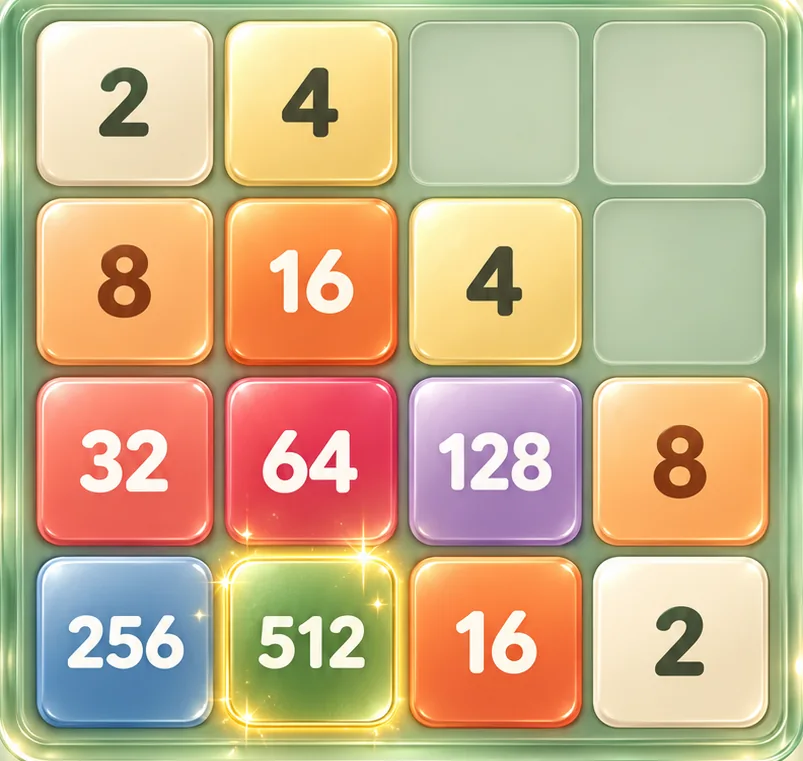
The first image shows a 4×4 position with several open squares in the upper-right corner. The bottom row already contains 256 and 512. Those large tiles are promising, but they need matching partners before they can grow. Meanwhile, the smaller numbers still need somewhere to move. Before sliding this sort of position, follow the route of the upper 4 and 8 as well as the big tiles below. These images are cropped promotional illustrations; the exact interface and the position in your own game may differ.
Why 2 and 4 stay separate
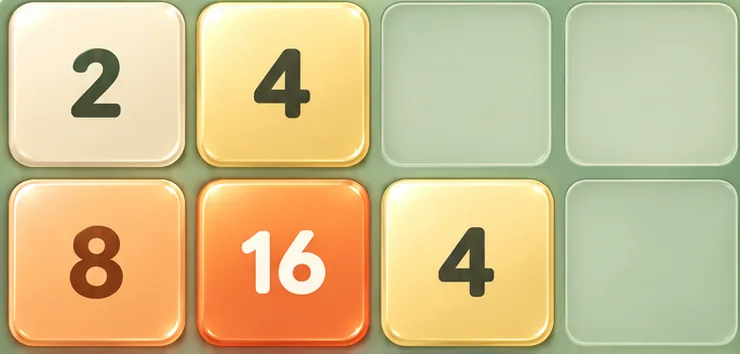
In the second crop, 2 and 4 sit above 8 and 16. Neighbouring squares do not automatically form a useful pair. Different values never merge, and you cannot swap any two tiles just because that would help. To grow the 4, you need another 4 that can reach it along a row or column. A move without points may therefore be useful preparation. It can align equal numbers or shift an obstacle out of the way. Thinking about those routes is often more productive than chasing the nearest available merge.
Keep large tiles organised
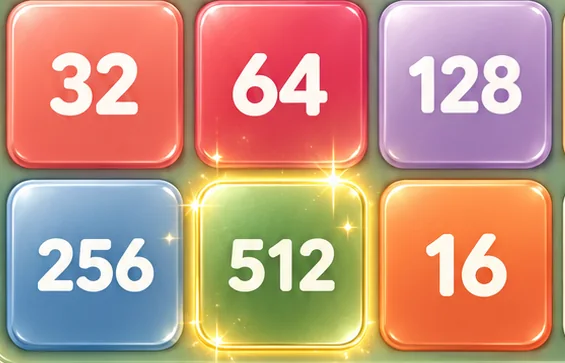
The third crop highlights 64, 128 and 512, surrounded by smaller values. One practical approach is to keep your highest tile near a corner and build other large numbers alongside it. Treat that as a guide, not a guaranteed winning formula. A tidy row still needs room to breathe. Two 128s are not much help if a different tile remains trapped between them. Before reversing direction, check whether you are opening a useful path or pulling apart a sequence you have carefully assembled. Choose the move that leaves you workable follow-up options.
Four grids, four amounts of space
Classic uses a 4×4 grid with a target of 2048. Hard reduces the board to 3×3 and sets the first target at 512. Easy offers 5×5 squares, while Zen expands the grid to 6×6. Both larger boards still target 2048. Extra squares give you more opportunities to organise and recover, but careless moves can fill any board. The game opens with Classic and no time limit selected. You can switch to your other saved runs through the controls. Each grid-and-timer combination has its own saved game and personal record.
Play without pressure or against the clock
Choose No limit when you want time to think. For a timed run, select 3 minutes, 5 minutes or Bonus time. The countdown starts with your first valid move. Bonus time begins at 60 seconds: a merge producing at least 32 adds one second, at least 128 adds two, at least 512 adds three, and at least 2048 adds five. Only the highest applicable threshold counts for each merge. Several merges in one move add their bonuses together. The clock keeps running in menus, background tabs and other modes. Undo is disabled during timed games.
Return to the same starting point
Daily is a separate untimed 4×4 challenge. Its starting layout follows the date in the Berlin time zone. Restarting on the same day uses the same starting setup and underlying random sequence, although your choices still shape the position that develops. That gives you a reason to revisit an idea and try another route. The daily reset follows Berlin time rather than your device’s local midnight. Daily records are personal records in your browser, however. This version does not provide a worldwide leaderboard or live competition against other player accounts.
The target tile is not your total score
The fourth illustration places two 1024 tiles beside a golden 2048. It captures the final step towards the classic target: bring two matching 1024s together to create one 2048. In an untimed game, reaching the goal lets you continue if moves remain. In a timed run, it does not stop the countdown; keep scoring until time expires or the board becomes unplayable. Your total score and your highest tile measure different things. Accumulating 2048 points does not mean you have created a 2048 tile on the board.

Make the game comfortable to use
The default appearance follows your device’s light or dark system setting. You can override it with the switch at the top right, then return to automatic appearance in Settings. Sound effects and optional background music have separate controls. Audio begins only after you interact with the page. Saved progress and best scores rely on local browser storage being available. Clearing that storage, switching browsers or moving to another device will not automatically carry your game across. Keep that in mind before cleaning your browsing data during a long-running session.
Frequently asked questions
Do I need to install anything?
2048 is free to play in your browser on alexo.org. No installation, account or sign-up is required. Your saves and personal bests stay locally in your browser.
When does a game end?
A game ends when no empty square and no legal merge remain. A timed run also ends when its countdown reaches zero. A full grid is not necessarily finished if matching neighbours can still merge.
Does sliding a tile earn points?
No. Points come from merges and equal the value of the newly created tile. Sliding without scoring can still be the right decision when it aligns a useful pair or improves the board layout.
Can I take back a mistake?
In an untimed game, Undo can restore up to 30 previous moves. Timed games do not allow it. Starting a new game resets the current board; after you have made moves, the game asks you to confirm.
Does leaving the page pause the timer?
No. The saved end time continues to apply in menus, background tabs and after reloading. Switching modes does not freeze a timed run either. Choose an untimed game if you expect interruptions.
Are personal bests shared across devices?
No. Records belong to the browser that stored them. Each grid size and timer setting is scored separately, so a relaxed 6×6 run is not mixed with a three-minute game on a 3×3 board.
More games for your next break
If you enjoy finding the right place for blocks, try PRISM BLOCKS. PONG tests your timing when returning the ball. In BRICK BREAKER, aim your rebounds to clear the bricks.